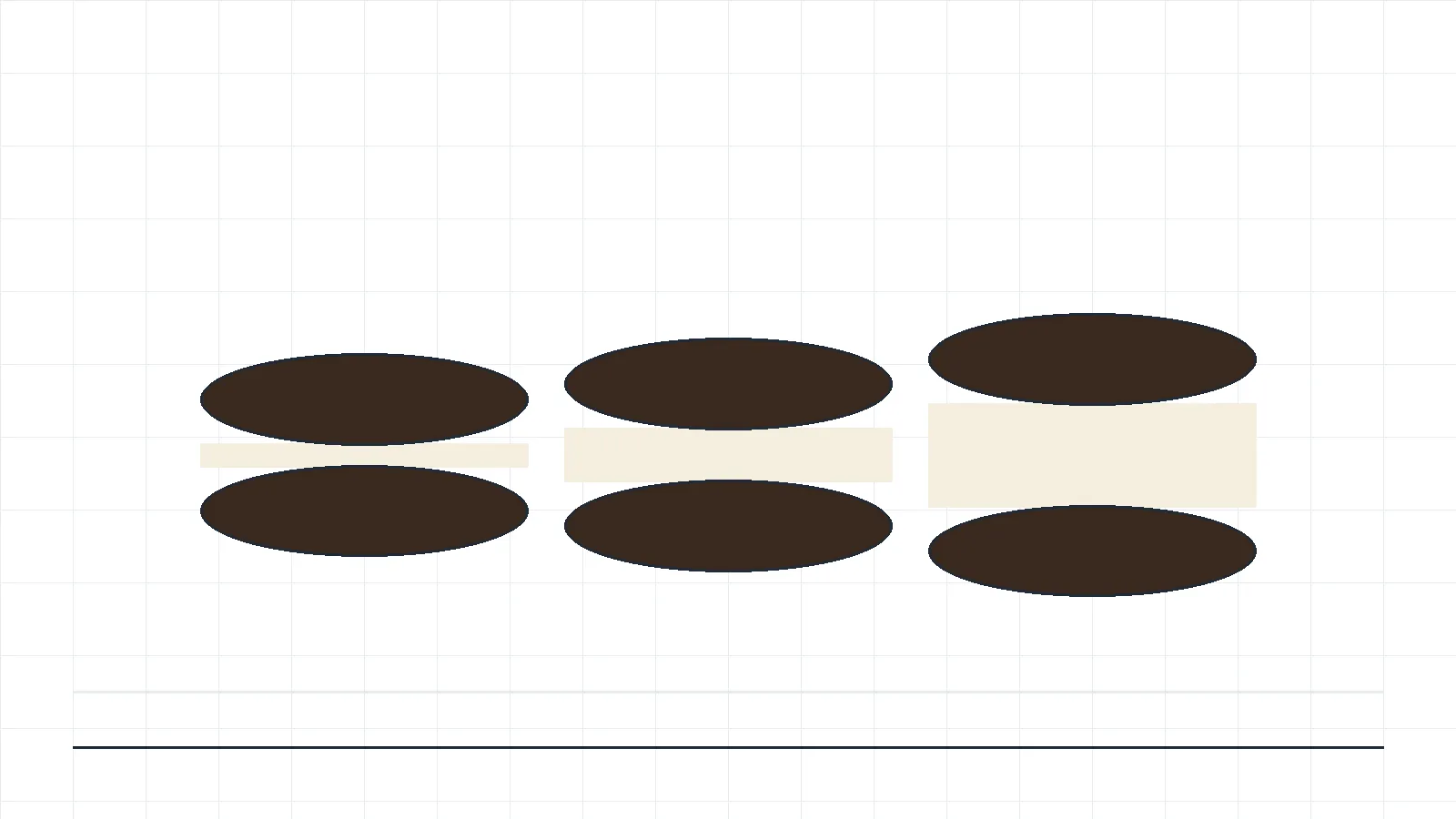
The Three Cookies at a Glance
Original, Double Stuf, and Thins look like three different cookies on the shelf, but they are one idea in three forms: two cocoa wafers around a sweet creme filling. What changes is how much creme sits between the wafers, how thick the wafers are, and how many cookies make one label serving. Everything else — the cocoa wafer, the original creme flavor, the way the cookie is sold — stays close to the same.
The table at the top of this page puts the three side by side. Read it with the serving size in mind: a serving is 3 cookies for Original, 2 for Double Stuf, and 4 for Thins, so the calorie numbers only make sense next to those servings. All figures on this page come from current US labels, checked in November 2026, and labels vary by country and by pack — check your own pack before comparing.
What Changes Between Them: Wafer, Creme, and Thickness
Only three things change between the three lines: the amount of creme, the thickness of the wafer, and the serving size on the label. The flavor idea does not change.
Original: The Baseline
Original is the classic cookie, first sold in 1912, and the reference point for the other two. Two chocolate cocoa wafers, a standard layer of original creme, and a crisp bite that softens in milk. When this page says a line has “more creme” or a “thinner wafer,” Original is the thing it is being compared with.
Double Stuf: About Twice the Creme
Double Stuf, introduced in 1974, keeps the same chocolate wafers and adds about twice the creme of an Original. Mondelēz describes it as “twice the OREO creme.” This page says “about twice” because an independent weighing found 1.86 times the creme of an Original — close to double, not a precise doubling. The extra creme makes the cookie softer and sweeter, and it is the reason the label serving is smaller: 2 cookies instead of 3.
Thins: Thinner Wafer, Thin Creme Layer
Thins, introduced in the US in July 2015, go the other way: a thinner wafer and a thin layer of creme, in chocolate and golden wafer varieties. The cookie is extra crisp and delicate, with fewer crumbs than the classic cookie. Because each cookie is lighter, the label serving is larger — 4 cookies instead of 3 — even though the serving weighs less than an Original serving (29 g against 34 g).
Nutrition and Serving Size, Side by Side
The three lines are easy to compare badly, because the serving sizes differ. Compare per serving first, then per cookie, and never one without the other.
Per label serving: Original is 160 calories per 3 cookies (34 g); Double Stuf is 140 calories per 2 cookies (29 g); Thins are 140 calories per 4 cookies (29 g). Sodium per serving is 130 mg for Original, 90 mg for Double Stuf, and 95 mg for Thins. Total sugars per serving are 14 g for Original (13 g added), 13 g for Double Stuf (13 g added), 11 g for Thins Golden (11 g added), and 12 g for Thins Chocolate (12 g added) — note that Thins Golden and Thins Chocolate do not share one sugar number.
Reading the Label: The Serving Size Is Not the Same
A serving is not “one cookie,” and it is not the same count across lines. Original counts 3 cookies as a serving, Double Stuf counts 2, Thins count 4. Any comparison that lines up the three calorie numbers without those counts is comparing different amounts of cookie. When you pick up a pack, read the serving first — the serving size, in cookies and in grams, is printed on the same panel as the calories.
Calories per Cookie vs Calories per Gram
Per cookie, the three lines sit far apart: about 53 calories for one Original, about 70 for one Double Stuf, and about 35 for one Thins. Those are derived figures — the label numbers divided by the cookie count — so they are always written with “about.”
Per gram, the three lines are nearly identical: about 4.7 calories per gram for Original and about 4.8 for Double Stuf and Thins. That is the number that matters for the “lighter” question. A Thins cookie has fewer calories because it is a smaller cookie, not because it is a different kind of food. This page does not rank the three as better or worse for health; the numbers above are the whole basis a reader needs, and any health decision should rest on the full label and the reader’s own diet, not on one line of this page.
Sodium works the same way: about 43 mg per Original cookie, about 45 mg per Double Stuf cookie, and about 24 mg per Thins cookie.
Ingredients and Allergens
The ingredient lists are largely similar, though formulations and ingredient order can vary by product and pack. The chocolate versions share a core list: unbleached enriched flour, sugar, palm oil, soybean and/or canola oil, cocoa (processed with alkali), high fructose corn syrup, leavening, salt, soy lecithin, chocolate, and artificial flavor. The order on the label varies a little — sugar comes first on the Double Stuf and Thins Chocolate labels checked, flour first on the Original label. Golden Thins are the exception: their wafer is vanilla, so the list has no cocoa or chocolate.
All three carry the same allergen statement on the US labels checked: “Contains: wheat, soy.” Milk is not an ingredient in any of the three US recipes, but the cookies are made on equipment shared with milk-containing products, so milk cross-contact is possible. Some packs outside the US carry a “may contain milk” warning for that reason; the US labels checked do not. Mondelēz does not label or certify OREO cookies as vegan — the full question is covered in the guides pillar.
Texture and Taste: Eating, Dunking, and Snacking
Texture is where the three lines differ most in the mouth, and it is also where this page stays qualitative: there are no measured dunking times or crunch scores here, only the differences a reader can expect.
Original is crisp first, then softens in milk — the classic dunking cookie. Double Stuf is softer and creamier from the extra creme, and it holds together longer when dunked, which suits a longer dunk. Thins are extra crisp and delicate, soften fastest in milk, and work better as a snack or a topping than as a dunking cookie, because the thin wafer gives way quickly.
Taste follows the proportions. Original and Double Stuf taste of the same original creme; Double Stuf tastes sweeter and creamier because there is more of it. Thins taste of the same creme too, but the thin layer means more wafer and less creme in each bite, so the wafer character comes through more.
Packs and Availability in the US
All three lines are sold in US retail as of November 2026. They are commonly sold in Family Size packs: Original in a 13.29 oz pack with about 11 servings, Double Stuf in an 18.71 oz pack with about 18 servings, Thins Chocolate in an 11.78 oz Family Size pack, and Thins Golden in a Family Size pack with about 13 servings. Many Family Size packs use resealable packaging. Those pack sizes are context for shopping, not the basis for the nutrition comparison — the nutrition figures above come from the label serving, whichever pack they were read from.
Availability varies by store and region, and not every variety is stocked everywhere. This page makes no claim about availability outside the US, and it lists no prices: prices change, and a price seen in one store is not a fact about the cookie.
Which One Fits Your Use?
- Eating plain: any of the three. Original is the straightforward default; Double Stuf if you want more creme; Thins if you want something crisp and light to snack on.
- Dunking: Original or Double Stuf. Thins soften fast, so they suit a quick dip rather than a long soak.
- Baking: Original gives the firmest crust, because its wafer crushes well and its creme binds a filling. Double Stuf adds sweetness and creme to fillings such as cheesecake and truffles. Thins work better sprinkled on top than pressed into a base. The recipes pillar shows which type suits each dessert.
- Snacking and sharing: Thins, in a resealable Family Size pack. Double Stuf also travels well as a single-serve snack.
- Choosing a pack: buy the size you will finish while the pack is fresh. The buying guide covers pack sizes and storage in full.
Common Mistakes When Comparing Them
- Comparing calories cookie for cookie without the serving size. Three Originals, two Double Stufs, and four Thins are the servings — not one cookie each.
- Treating Thins as the healthy option. Per cookie they have fewer calories, but per gram they are nearly identical to Original. There is no health ranking on this page.
- Treating “about twice” as a precise measurement. Double Stuf has about twice the creme; the point is the proportion, not a laboratory figure.
- Using one sugar number for Thins. Thins Golden and Thins Chocolate differ (11 g and 12 g of sugars per serving). Always name the variant.
- Reading a UK or European label as if it were the US one. Recipes, serving sizes, and allergen warnings vary by market; the figures on this page are US labels.
- Assuming one store’s stock or price applies everywhere. Availability and price vary by store and region, and this page claims neither.